

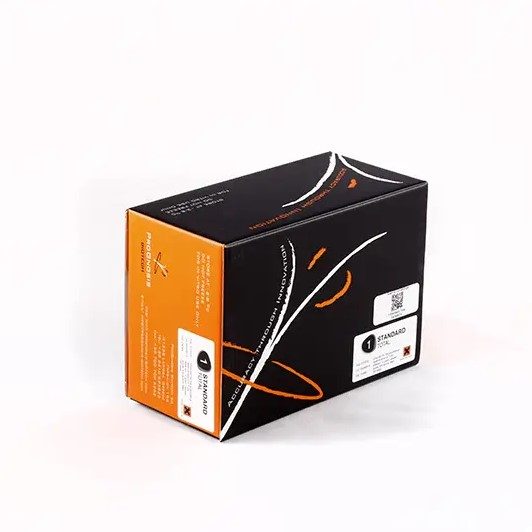
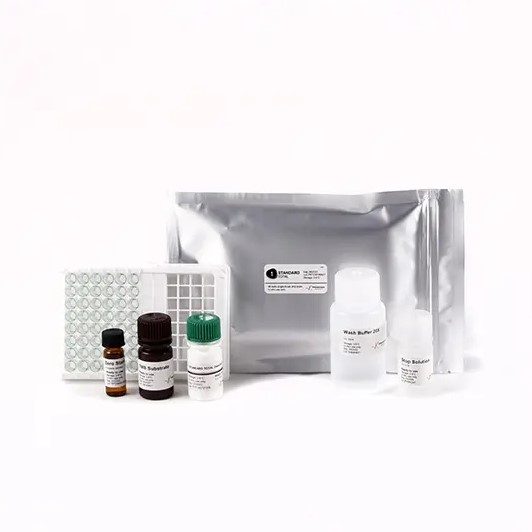
1-STANDARD TOTAL
- The kit is used to detect whether mycotoxins are present and to measure how much of these mould-produced toxins are in the sample.
- Competitive Quantitative mycotoxin test kit, ELISA test with single break strip plate, 48 wells (6 strips)
- Only one standard is required.
- ELISA procedure takes 5 minutes
- LOD (limit of detection): 0.6 ppb
- Quantification range: 1-50 ppb
- Specificity and sensitivity are really high.
- All reagents are ready to use.
- Adapted to the legal limits of the United States and Asia
- 12 months shelf life
- Storage 2 to 8 °C
Mycotoxins are toxic compounds that can appear when certain moulds grow on crops, food, animal feed or other agricultural materials. They’re commonly found in cereal grains, peanuts, dried fruits and tree nuts, especially when these products are stored in warm and humid conditions. Examples such as aflatoxin, ochratoxin, ergot alkaloids, patulin, T-2/HT-2, fumonisin and zearalenone have been linked to a range of health problems in both humans and animals.
SPECIFICATIONS
- 1-Standard Total is an ELISA test for the quantitative determination of Aflatoxins B1, B2, G1, G2 in grains, nuts, spices, cereals and animal feed.
- The test provides a cost-effective, and reliable solution to the analyst, including only the standard 1 (zero standard) in the kit.
DETAILS
The 1-Standard ELISA series is a novel ELISA system that uses a precalibrated curve to quantify mycotoxins in under 5 minutes. Unlike the typical ELISA methodology, which requires numerous standards for proper quantification, the 1-standard ELISA protocol only requires the single (analyte-free) standard.
The key advantage of the regular ELISA, the mycotoxin test kit is that slight or occasionally larger differences in the individual experiment (time delays or temperature variations) are similar for both standards and samples, minimising their impact on the results. As a result, in order to maintain the same benefit in terms of accuracy, the 1-standard ELISA series continues to use the analyte free standard.
The precalibrated standard curve has been run several times in ProGnosis Biotech facilities, and after extensive checks and validations, it is unique for each lot and can be downloaded using the Prognosis Data Reader. When analysing a single sample, the 1-Standard ELISA requires only two ELISA wells, as opposed to six (or more) with the conventional ELISA.
Applications and Benefits
Food Safety: Mycotoxin test kits help protect the food supply by checking for toxins that can develop when mould grows on crops. Contamination can happen while the crops are growing, during harvesting, or later in storage, so regular testing is important to keep food products safe.
Health Monitoring: Certain kits are also used in clinical settings to check if a person has been exposed to mycotoxins. This helps doctors identify possible health issues that may be linked to mould exposure.
Rapid Results: Many mycotoxin test kits are built to give quick readings, so producers can make decisions without waiting. They’re widely used to check for toxins in food and feed, and there are different kit options depending on what needs to be tested. Overall, they help farmers and manufacturers keep mycotoxin problems under control.
Steps to use
The process begins with pulling the mycotoxins out of the sample, typically by grinding it and mixing it with a solvent so the toxins move into the liquid. That extract is then added to the antibody-coated wells on the ELISA plate, where the mycotoxins in the sample compete with the enzyme-labelled ones from the kit.
The plate then sits for the needed incubation time. After that, the wells are washed to remove anything that didn’t attach properly. A substrate is added next, which reacts with the enzyme and produces a colour change that indicates the level of mycotoxins present. A stop solution is added at the end to lock in the colour for measurement.
In Summary
ELISA mycotoxin test kit is commonly used for mycotoxin testing because they’re straightforward to run, sensitive enough to pick up low levels of toxins, and able to deliver results quickly. They’re widely relied on in food safety and agriculture to help ensure that food and feed meet the required health standards for mycotoxin limits.

Frequently Asked Questions (FAQs)
What mycotoxin test kits can detect?
Mycotoxin test kits can detect a range of mycotoxins including Aflatoxin, DON (Deoxynivalenol), Zearalenone, Fumonisin, Ochratoxin, T-2 Toxin.
How long does the test take?
The test is fairly quick. After the setup is done, it usually takes around five minutes to complete, so it fits easily into a typical lab workflow without causing delays.
Who usually uses this test kit?
This kit is used by a mix of people in the food and agriculture sector, from laboratory technicians to grain and nut processors, and even feed producers. Regulatory bodies also rely on it when they need dependable mycotoxin checks before products move further down the supply chain.
What types of samples can be tested?
It can handle a variety of sample types. Most users run it on cereals, grains, nuts and spices, but it’s also suitable for different kinds of animal feed, making it flexible enough for both food and feed testing needs.
How many samples do I need for the test kits?
You only need a small amount of material for the test. Most labs grind and homogenise a portion of the grain, nut or feed, then take a measured subsample for extraction. The exact amount can vary depending on the lab’s workflow, but the kit itself doesn’t require a large quantity, just enough extract to fill the wells for analysis.